

Sloths in Costa Rica
Meet Costa Rica’s Slowest Residents. Two species. One lush canopy. Everything you need to know about Sloths.
Date: November, 2026
Costa Rican Sloths
Costa Rica is home to two sloth species: the Brown-throated Three-toed Sloth and Hoffmann’s Two-toed Sloth. Despite a common myth that one lives on the Pacific coast and the other on the Caribbean, both species actually thrive on both sides of the country and frequently share the exact same canopies. Rather than being separated by coastlines, their habitats are shaped by climate and elevation, both flourish across the country's warm, humid lowlands, avoiding only the freezing mountain peaks and the dry northwest.
Sloths are uniquely built for an upside-down life high in the trees. Their long curved claws, which are actually extensions of their finger and toe bones, act like natural hooks, requiring zero muscle energy to hang even while sleeping. They have remarkably strong limbs for climbing, extra neck bones that allow three-toed sloths to turn their heads nearly 270 degrees, and internal organs anchored to their ribs so their weight doesn't press down on their lungs while hanging upside down.
Three-toed Sloth
Scientific name: Bradypus variegatus. The Brown-throated Three-toed Sloth is the country's most commonly sighted and iconic slow-moving resident. Easily recognized by its distinctive facial markings that resemble a gentle bandit mask, a stubby tail, and three visible claws on each limb, this species has a rounded head and a permanent, peaceful smile.
Three-toed sloths are strictly arboreal and diurnal, meaning they spend their days high in the canopy basking in the sun and feeding almost exclusively on the leaves of specific tree species like cecropia. Three-toed Sloths can be found thriving across a wide range of Costa Rica's humid lowlands and mid-elevations, from the dense rainforests of Corcovado and Tortuguero to the lush secondary forests of Manuel Antonio and the Caribbean coast.

A ThreeToed Sloth close-up.
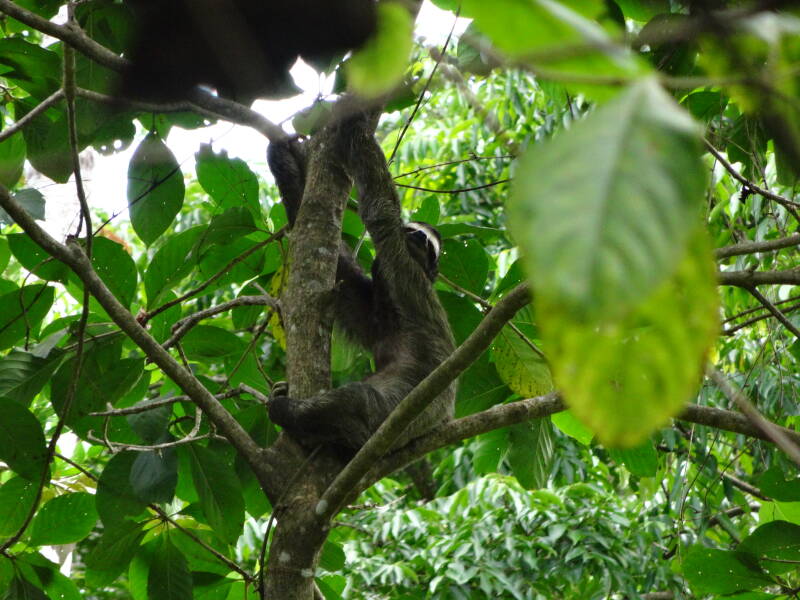
Three-Toed Sloth high up in the trees.

Sloth crossing the street in Puerto Viejo de Talamanca.
Two-toed Sloth
Scientific name: Choloepus hoffmanni. Hoffmann's Two-toed Sloth is slightly larger, possesses a more shaggy, light-brown coat, and lacks the facial bandit mask of its three-toed cousin. True to its name, it features two prominent claws on its front limbs (and three on the hind), along with a more snout-like nose and longer, coarser fur.
Unlike their diurnal relatives, two-toed sloths are primarily nocturnal, often spending daylight hours curled up tightly high in the branches before becoming active after dark to feed on leaves, shoots, and occasionally fruits or flowers. While they share overlapping territory with three-toed sloths in Costa Rica's lowland rainforests and tropical wet zones, such as Caribbean coast, the Sarapiquí region, and the South Pacific, they tend to prefer slightly higher elevations and denser primary forest canopies, making them a bit more difficult to spot during daytime wildlife tours.
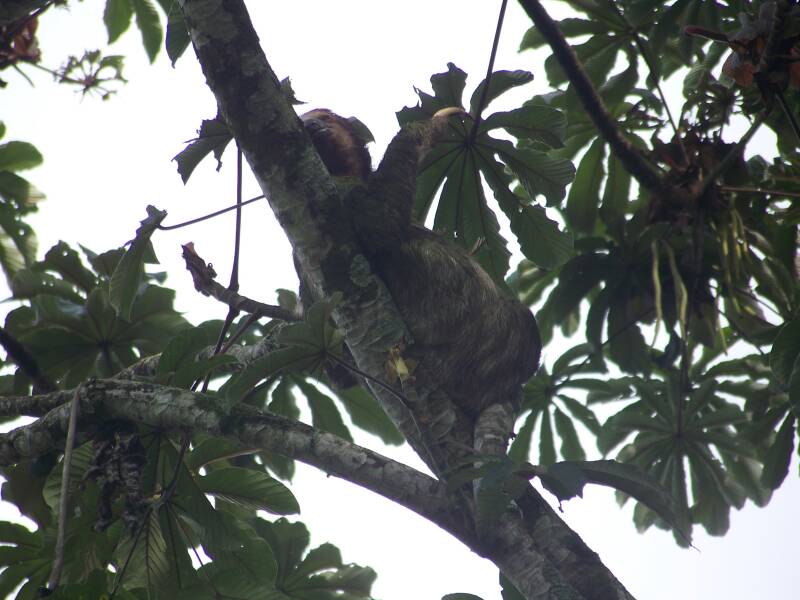
Two-Toed Sloth high up in the trees.
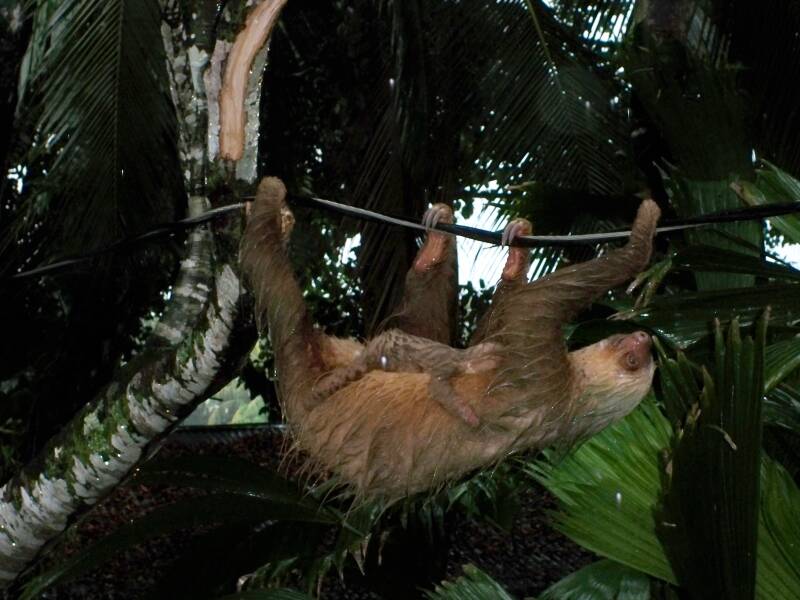
A Two-Toed Sloth carying a pup near Cahuita.

Sloth at the Jaguar Rescue Center in Puerto Viejo.
Website Logo
Yes, the logo of this website is a sloth! Although you might think I have chosen this animal because it appears to be so relaxed and lazy, sloths are actually three times stronger than humans relative to size, possessing a grip so unbreakable they can stay hanging without using energy, and are tough enough to survive a fall from the rainforest canopy without a scratch. So, this website mascot represents pure strength and resilience—that's obviously why I have chosen a sloth, right?!...