

Gallo Pinto
If there is one dish that truly captures the heart of Costa Rican cuisine, it is Gallo Pinto. This traditional mix of rice and beans forms an essential part of daily life. Gallo Pinto became one of those dishes that I genuinely look forward to.
Date: November, 2026
The Famous Gallo Pinto
Gallo Pinto is a traditional Costa Rican dish made from rice and black beans. Although every household has its own recipe it is generally cooked together with onions, sweet peppers, cilantro, and spices. This dish is deeply rooted in everyday Costa Rican life. The secret to its distinctive flavor lies in the seasoning. In Costa Rica, many families add Salsa Lizano, a slightly sweet and tangy sauce that has become almost synonymous with Gallo Pinto.
It is most served at breakfast with side dishes like eggs, fresh or fried cheese, sour cream (natilla), fried plantains, tortillas, or sliced avocado. My favorite side sih however is salchichón. In Costa Rica, the salchichón served with Gallo Pinto is a mild, large-diameter cured pork sausage that is sliced into thick parts and pan-fried.
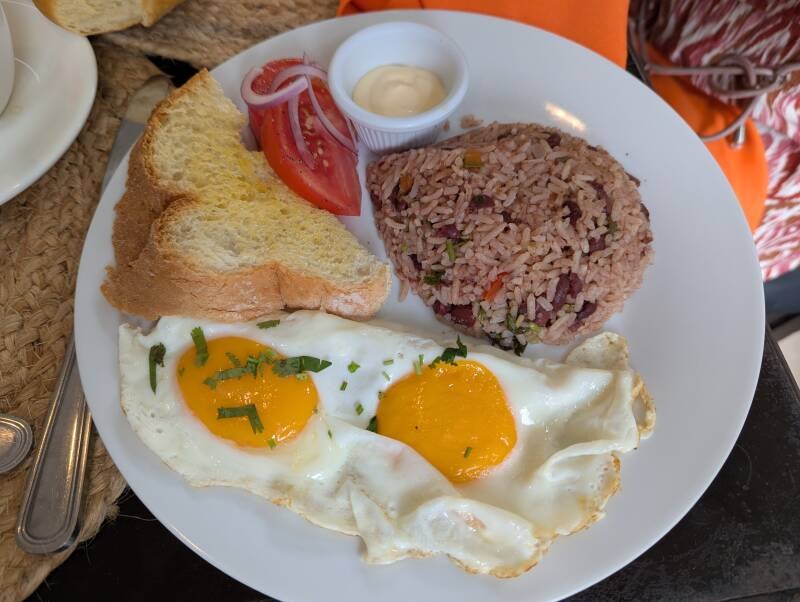
Hotel served Gallo Pinto breakfast.

Home made Gallo Pinto with eggs and salchichón on the side.

A typical Costa Rican breakfast table.
Salsa Lizano
Salsa Lizano is Costa Rica’s beloved national salsa It is a light-brown table sauce that sits on almost every restaurant and home kitchen table across the country. Created in 1920 by Próspero Lizano, it has a complex, savory-sweet, and mildly tangy flavor profile.
Salsa Lizano serves as the essential secret ingredient in Gallo Pinto, while also elevating everything from scrambled eggs and tamales to grilled meats and and other dishes.
Unlike traditional hot sauces, the original Salsa Lizano with the green cap is not spicy, but there is a spicy version with a red cap.

Salsa Lizano.
The Name Gallo Pinto
The name Gallo Pinto literally translates to "spotted rooster" or "painted rooster." At first glance, that may seem like a strange name for a rice and bean dish. The most widely accepted explanation is that the mixture of white rice and dark beans creates a speckled appearance resembling the feathers of a spotted rooster. Over time, the dish became so popular that the name remained, eventually becoming one of the culinary symbols of Costa Rica. Asking for Gallo Pinto at breakfast is as normal as ordering coffee.
Caribbean Rice & Beans
When you travel to the Caribbean coast, where English words are more common due to the cultural history of the region, you might assume that Rice & Beans on the menu is just the regional name for Gallo Pinto. While both contain rice and beans, they are actually quite different. Spoiler alert, they both are delicious!
Gallo Pinto is found throughout most of Costa Rica. Rice & Beans, on the other hand, originates from the country's Caribbean region, particularly around Puerto Viejo, Cahuita, and Limón. It reflects the Afro-Caribbean heritage of the area. It is traditionally cooked with coconut milk, thyme, and spices. The result is a richer and more aromatic dish with a completely different flavor profile. Where Gallo Pinto is usually served as breakfast, Rice & Beans is more commonly served as lunch or dinner.

Caribbean Rice and Beans, fragrant and tasty.
Related Pages
- Read more about typical Costa Rican food on the Costa Rican Food page.
- Want to know more about the Caribbean coast and the Afro-Caribbean culture in Costa Rica? Read The South Caribbean page or the story about Calypso Music.